
Sri Lanka Medical Council
Protecting the public through regulation of medical practice in Sri Lanka.
Introduction
The Sri Lanka Medical Council (SLMC) is the statutory authority responsible for regulating medical practitioners and maintaining standards of medical education, professional conduct, and patient safety in Sri Lanka.
SLMC works to ensure that medical practitioners are appropriately qualified, professionally competent, and ethically responsible to practice medicine in Sri Lanka. Through regulation and oversight, the Council aims to protect the public and maintain confidence in the healthcare system.
Protect the Public
Ensure that only qualified, competent, and ethical healthcare practitioners are authorised to practise in Sri Lanka.
Regulate Medical Practice
Maintain professional registers, oversee regulatory processes, and address complaints relating to healthcare practitioners.
Maintain Professional Standards
Regulate medical education, professional conduct, and ethical practice to maintain high standards in healthcare.
History
The development of medical regulation in Sri Lanka is closely linked to the history of medical education and the growth of the healthcare system in the country.
Early Development of Medical Education
The Colombo Medical School, the oldest medical school in Sri Lanka, was established on 1st June 1870 with an initial intake of twenty-five students. Graduates were awarded the Licentiate in Medicine and Surgery (L.M.S.) diploma.
In 1880, the institution was renamed the Ceylon Medical College, and the L.M.S. qualification was recognised by the General Medical Council, allowing graduates to be registered without additional examinations.
Introduction of Medical Registration
Formal regulation of the medical profession began with the Medical Registration Ordinance of 1905. Under this law, holders of the L.M.S. (Ceylon) qualification were recognised as medical practitioners and were registered to practise medicine and surgery by the Ceylon Medical College Council (CMCC).
The ordinance also allowed practitioners registered in countries that recognised the L.M.S. qualification to be registered locally.
The same legislation introduced provisions for removal of a practitioner’s name from the register, and subsequent amendments strengthened the disciplinary framework. The Medical (Amendment) Ordinance No. 26 of 1927 introduced provisions for erasure from the register on disciplinary grounds.
The Medical (Amendment) Act No. 30 of 1987 later introduced the requirement for renewal of registration every five years.
The procedures currently followed for disciplinary inquiries were later formalised in the Government Gazette No. 757/7 of 10 March 1993.
Recognition of University Qualifications
Following the establishment of the University of Ceylon under the University Ordinance of 1942, the MBBS and BDS degrees awarded by the university were recognised for registration by the Ceylon Medical College Council.
The Medical (Amendment) Act No. 23 of 1955 introduced provisional registration, enabling newly qualified medical graduates to gain supervised clinical experience through a period of internship before obtaining full registration. This legislation also introduced good character as a requirement for registration.
Regulation of Other Health Professions
The Medical Registration (Amendment) Ordinance No. 36 of 1908 provided for the registration of apothecaries and estate dispensers to practise medicine in the government sector with approval from the Principal Civil Medical Officer, the equivalent of the present Director General of Health Services.
The Dentists Registration Ordinance of 1915 established a system for registering dentists to practise dentistry.
The Medical Ordinance No. 26 of 1927 introduced provisions for the registration of pharmacists, restricting the dispensing of drugs and poisons to registered pharmacists and pharmaceutical chemists.
Registration of Nurses and Midwives
Midwives were originally registered under the Midwives Ordinance No. 2 of 1920, and provisions for their registration were later included in the Medical Ordinance of 1924. Registration as a midwife was restricted to women under the legislation in force at that time.
The Medical Ordinance No. 10 of 1949 provided for the registration of nurses by the Ceylon Medical Council. This responsibility was later transferred to the Sri Lanka Nurses Council, established under Act No. 19 of 1988 and later amended by Act No. 35 of 2005.
Development of Allied Health Professions
The Medical (Amendment) Act No. 30 of 1987 introduced provisions for the registration of para-medical assistants. This category included professionals such as radiographers, medical laboratory technologists, physiotherapists, occupational therapists, electrocardiograph recordists, audiologists, clinical physiologists, speech therapists, chiropodists, dietitians, ophthalmic auxiliaries and clinical psychologists.
Later reforms recognised the increasing professional status of several of these disciplines. The Medical (Amendment) Act No. 40 of 1998 established a separate category known as Professions Supplementary to Medicine, which included radiographers, medical laboratory technologists, physiotherapists, and occupational therapists.
Temporary & Foreign Qualification Registration
Medical (Amendment) Act No. 30 of 1987 makes provision for persons who are employed as medical officers in government service to be granted registration during the period of such employment.
Further provisions were introduced under the Medical (Amendment) Act No. 37 of 1961 to allow temporary registration of medical practitioners, dentists, and nurses invited by the Government to serve in Sri Lanka.
This was later amended by the Medical (Amendment) Act No. 31 of 1997, which provided that such registration may be recommended by the Secretary to the Ministry of Health, the Director General of Health Services, or the Dean of a Medical Faculty. Temporary registration is normally granted for a limited period of up to twelve months, subject to the Council’s assessment of the applicant’s qualifications and competence.
Registration of Practitioners with Foreign Qualifications
The Medical (Amendment) Act No. 16 of 1965 introduced provisions for the registration of Sri Lankan citizens who obtained medical qualifications from recognised foreign medical schools. Registration was granted after passing a special examination conducted by the Council and completing a period of internship.
This examination was previously known as the Act 16 Examination and is now conducted as:
the Examination for Registration to Practise Medicine (ERPM), and
the Examination for Registration to Practise Dental Surgery (ERPDS).
Medical (Amendment) Act No. 30 of 1987 makes provision for persons who are employed as medical officers in government service to be granted registration during the period of such employment.[
The Medical (Amendment) Act No. 15 of 1996 also introduced provisions allowing certain Sri Lankan citizens with foreign medical qualifications to be registered if they had been employed in the Department of Health Services prior to 17 May 1991.
Registration of Specialists
More recently, the Medical (Amendment) Act No. 28 of 2018 introduced provisions for the registration of medical and dental specialists, recognising advanced professional training and expertise within the healthcare system.
Core Responsibilities
The Sri Lanka Medical Council carries out a range of regulatory functions to maintain standards within the medical profession. These responsibilities help ensure safe, ethical, and professional healthcare delivery in Sri Lanka.
Recognition of Medical Qualifications and Training Programs
SLMC evaluates and recognises medical qualifications and training programmes to ensure they meet accepted standards for professional practice. This process helps maintain the quality and consistency of healthcare education and training.
Regulation and Accreditation of Medical Education
SLMC works to maintain standards in undergraduate and postgraduate medical education by monitoring educational programmes, training institutions, and internship pathways. Accreditation processes help ensure that healthcare professionals receive appropriate training before entering practice.
Registration of Medical, Dental and Allied Healthcare Practitioners and Specialists
SLMC is responsible for registering qualified medical, dental, and allied healthcare practitioners who meet the required educational and professional standards. The Council maintains official registers to ensure that only authorised professionals are permitted to practise in Sri Lanka.
Maintenance of Professional and Ethical Standards
SLMC promotes high standards of professional conduct, ethics, and patient care among healthcare practitioners. The Council provides guidance on professional behaviour and expects practitioners to practise safely, competently, and ethically.
Investigation of Complaints and Disciplinary Matters
SLMC investigates complaints relating to the professional conduct or fitness to practise of registered practitioners. Where necessary, the Council may conduct disciplinary proceedings and take appropriate regulatory action to protect patients and uphold professional standards.
Advising on Matters Related to Medical Practice and Education
SLMC provides expert advice and recommendations on matters relating to medical practice, healthcare education, professional standards, and regulatory policy. The Council works closely with government institutions, universities, and healthcare organisations to support the development of safe and effective healthcare services.
Public Protection Role
Protecting the public is the primary responsibility of the Sri Lanka Medical Council. All decisions made by the Council are guided by the principles of fairness, accountability, transparency, and public interest.
SLMC helps safeguard patients and maintain public trust by ensuring that:
Maintains Education & Training Standards
SLMC helps maintain the quality of medical education and training by recognising approved qualifications and monitoring educational and training standards.
Registers Qualified Practitioners
SLMC ensures that only individuals who meet approved educational, professional, and legal requirements are registered and authorised to practise medicine in Sri Lanka.
Promote Professional & Ethical Standards
SLMC promotes safe, ethical, and professional medical practice by establishing standards of conduct and guiding healthcare practitioners on their professional responsibilities.
Investigates Complaints
SLMC reviews and investigates complaints relating to registered practitioners through established procedures to ensure fairness, transparency, and protection of the public.
Takes Regulatory Action to Safeguard Patients
Where necessary, SLMC may take regulatory or disciplinary action to address concerns relating to professional conduct, competence, or patient safety.
Acts & Regulations
The legislative framework governing the Sri Lanka Medical Council — including the Medical Ordinance, its amendments, and subsidiary regulations gazetted under its authority.
Overview
The Sri Lanka Medical Council operates within a comprehensive legislative framework that defines its authority, functions, and obligations. This framework comprises the primary enabling legislation — the Medical Ordinance — and a body of subsidiary regulations and gazette notifications that govern specific operational matters.
All documents published on this page are official instruments that carry the force of law. Registered practitioners and the public are entitled to access these documents, which set out rights, duties, fees, and procedures under SLMC regulation.
Principal Acts
Primary legislation enacted by Parliament governing SLMC
Regulations
Subsidiary rules made by the Council under delegated authority
Gazette
Official notices published in the Government Gazette
Principal Acts
Medical Ordinance
The primary enabling legislation establishing the Sri Lanka Medical Council. Defines the composition, powers, and functions of the Council; the registration framework for medical and dental practitioners; qualification recognition; and the disciplinary jurisdiction of the Council.
Medical (Amendment)
This Act may be cited as the Medical (Amendment) Act, No. 46 of 2024
Guidelines
The SLMC issues subsidiary regulations under powers granted by the Medical Ordinance. These instruments govern specific operational matters and carry the same legal force as the parent Act once gazetted.
Medical & Death Certificates
Guidelines
Guidelines for Medical Practitioners and Dentists regarding the Issue of Medical Certificates
Download PDFInstructions on Serious Professional Misconduct for Medical Practitioners and Dentists
Professional Guidelines
This document provides guidance on serious professional misconduct applicable to registered medical practitioners and dentists.
Download PDFGuidelines on Ethical Conduct for Medical and Dental Practitioners Registered with the Sri Lanka Medical Council
Professional Ethics
This document sets out the ethical principles and professional standards expected of medical and dental practitioners registered with the Sri Lanka Medical Council (SLMC).
Download PDFSocial Media Guidelines for Registrants of the Sri Lanka Medical Council
Professional Ethics
This document provides guidance on the responsible and professional use of social media by registrants of the Sri Lanka Medical Council (SLMC).
Download PDFGazette
The following gazettes have been issued by the SLMC under the Medical Ordinance. All gazettes are published in the official Government Gazette of Sri Lanka.
Medical (Maintenance of Minimum Standards of Medical Education)
2018-01-26
The Medical (Maintenance of Minimum Standards of Medical Education)
2019-12-26
Regulation on Medical (Maintenance of Minimum Standard of Medical Education)
2021-04-10
Appointment of Registrar
2014-02-28
For gazettes not listed here or for certified copies, contact the SLMC Registrar's Office at info@slmc.gov.lk or visit the Government Printer website.
Organisational Structure
Overview
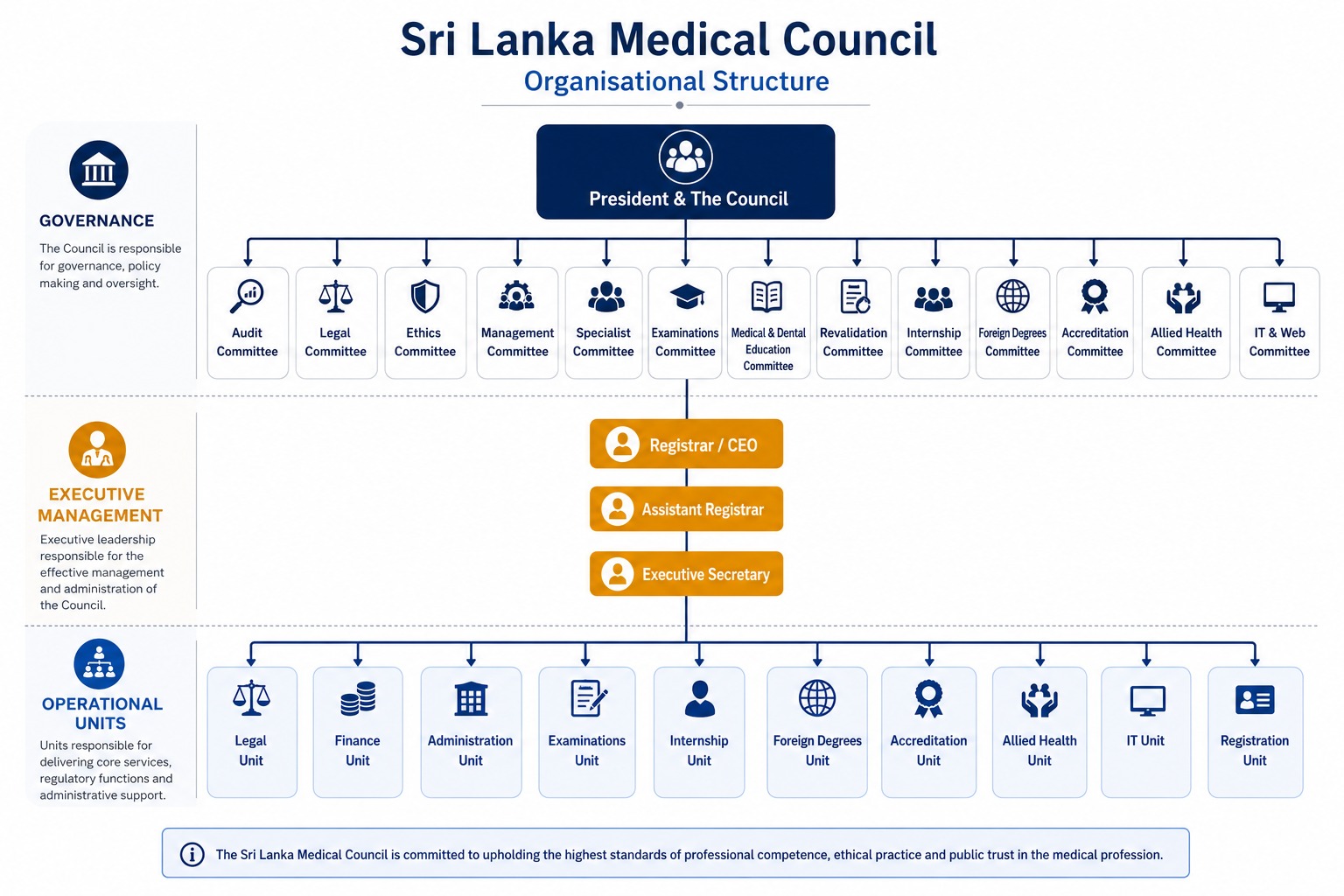
The Sri Lanka Medical Council operates through a structured administrative and regulatory framework designed to support its statutory responsibilities. The Council functions through a combination of governing bodies, statutory committees, and administrative divisions that work together to implement its regulatory mandate.
At the policy level, the Council itself provides overall direction and decision-making authority. Several committees appointed by the Council assist in carrying out specific regulatory functions such as registration, recognition of qualifications, professional conduct, education, and disciplinary matters.
The day-to-day operations of the SLMC are managed by the Secretariat under the leadership of the Registrar. The Secretariat is responsible for implementing Council decisions, maintaining professional registers, managing applications and documentation, coordinating Council and committee meetings, and facilitating communication with practitioners, institutions, and the public.
This structured approach enables the Council to perform its regulatory duties efficiently while ensuring transparency, accountability, and adherence to statutory requirements.
Governing Body
The President and the Council is responsible for governance, policy development, and ensuring that SLMC fulfils its statutory responsibilities.
Secretariat
The administrative arm of SLMC under the leadership of Registrar is responsible for managing regulatory services, operations, and stakeholder engagement.
Committees
Standing committees support the Council by providing specialised expertise and recommendations on regulatory matters.
Organizational Chart
SLMC Organizational Chart
Official governance hierarchy
The Council
The Council is the supreme governing body of SLMC, exercising all statutory powers vested under the Medical Ordinance. It sets policy, oversees professional standards, and makes decisions on matters of registration, discipline, and education.
President
Section 12.1 (a)Appointed by the Minister
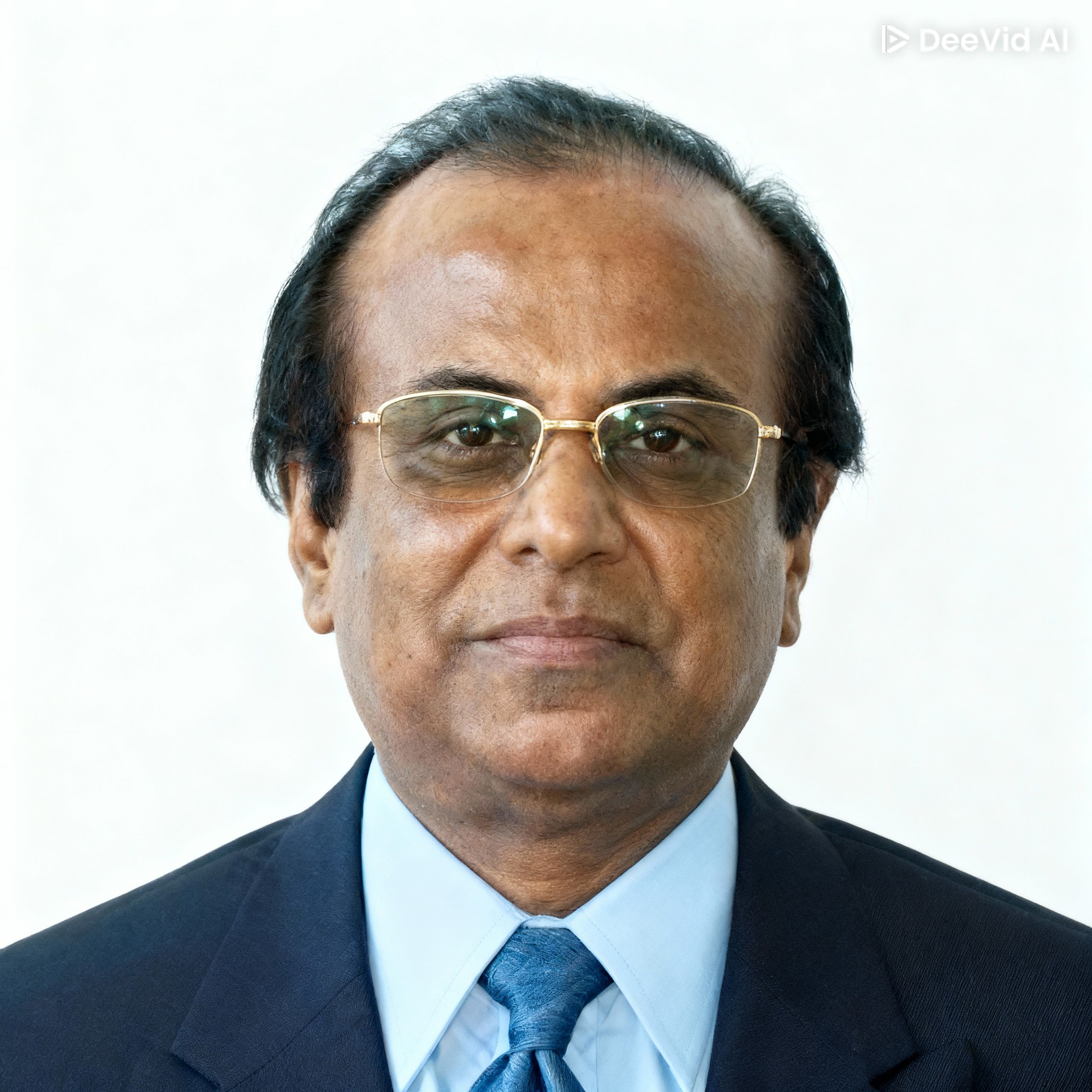
Prof. Jayantha Jayawardena
Since Sep 2025 – Present
Prof. Harendra de Silva
Prof. Harendra de Silva
Prof. Colvin Goonaratna
Prof. Carlo Fonseka
Prof. Lalitha Mendis
Dr. H. H. R. Samarasinghe
Dr. G. C. Uragoda
Dr. S. A. Cabraal
Dr. O. R. Medonza
Dr. S. H. P. Nanayakkara
Dr. E. M. Wijerama
Sir Nicholas Attygalle
Dr. W. A. Karunaratne
Dr. J. Kahawita
Dr. W. G. Wickramasinge
Dr. S. F. Chellappa
Dr. S. T. Gunasekara
Dr. R. Briercliffe
Dr. J. O. B. Van Langenberg
Lt. Col C. D. Myles
Dr. N. Duncan Walker
Vice President
Section 12.1 (c)Member Elected by Medical Practitioners (Section 29)
Dr E.G.D.Chandika Epitakaduwa
Since Jan 2025 – Present
Prof. Ranil Fernando
Prof. Jayantha Jayawardane
Prof. Surangi Yasawardene
Prof. Jayantha Jayawardane
Dr. S. Shanmuganathan
Prof. Nilanthi de Silva
Dr. Lalantha Ranasinghe
Dr. Ananda Hapugoda
Dr. Nanda Amarasekera
Dr. Ananda Samarasekera
Dr. W. S. S. de Alwis
Dr. S. M. G. Wijegoonaratne
Dr. S. A. Cabraal
Dr. W. D. L. Fernando
Dr. E. M. Wijerama
Sir Nicholas Attygala
Prof. John R. Blaze
Sir Nicholas Attygala
Dr. Frank Gunasekara
Dr. Lucian de Zilva
Member
Section 12.1 (b)Member elected by the teachers of the Faculty of Medicine
Prof.R.Surenthirakumaran
Dean, Faculty of Medicine, University of Jaffna
Prof. Madawa Chandratilake
Dean, Faculty of Medicine, University of Kelaniya
Prof. Saman Nanayakkara
Dean, Faculty of Medicine, University of Peradeniya
Snr Prof. T.P.Weerarathna
Dean, Faculty of Medicine, University of Ruhuna
Dr. Janaka Pushpakumara
Dean, Faculty of Medicine and Allied Sciences, University of Rajarata
Prof. Manori Gamage
Dean, Faculty of Medical Sciences, University of Sri Jayewardenepura
Dr. Sanjeewa Bowatte
Dean, Faculty of Medicine, Wayamba University of Sri Lanka
Prof. B.M.H.S.K. Banneheka
Dean, Faculty of Dental Sciences, University of Peradeniya
Prof.Muditha Vidanapathirana
Dean, Faculty of Medicine, Uva Wellassa University of Sri Lanka
Prof.Pujitha Wickramasinghe
Nominee of the Faculty of Medicine, University of Colombo
Member
Section 12.1 (b)Member elected by the teachers of the Faculty of Dental Science
Prof. Priyanke Palipane
Dean, Faculty of Dental Sciences, University of Sri Jayewardenepura
Member
Section 12.1 (bb)Member Elected by Medical Practitioners (Section 29)
Dr A.M.D.M.Indika Lanerolle
Member Elected by Medical Practitioners (Section 29)
Dr C.S.Dharmaratne
Member Elected by Medical Practitioners (Section 29)
Dr PWC Panapitiya
Member Elected by Medical Practitioners (Section 29)
DR Y.V.N.Dharshana Sirisena
Member Elected by Medical Practitioners (Section 29)
Dr R.N.A.M.U.K.Bandara Warakagoda
Member Elected by Medical Practitioners (Section 29)
Dr W.A.D. Thenuwan Tharanga Wickramasinghe
Member Elected by Medical Practitioners (Section 29)
Dr Haritha Punu Aluthge
Member Elected by Medical Practitioners (Section 29)
Member
Section 12.1 (c)Member Elected by Medical Specialist Practitioners (Section 39B)
Prof. Janaka de Silva
Member Elected by Specialist Dental Practitioners (Section 39B)
Dr. S R Wijayasinghe
Member Elected by Specialist Medical Practitioners (Section 39B)
Dr. M.D. Samarasinghe
Member Elected by Specialist Medical Practitioners (Section 39B)
Member
Section 12.1 (cc)Member Elected by Dental Specialist Practitioners (Section 39A)
Dr. Gamini Nawarathne
Member Elected by Specialist Dental Practitioners (Section 39B)
Member
Section 12.1 (ccc)Member Elected by persons entitled to practice medicine registered (Section 41)
Dr. D. S. Samaraweera
Member Elected by Registered Medical Practitioners (Section 41)
Member
Section 12.1 (d)Member Elected by Dentists Registered (Section 43)
Dr. S.Shanmuganathan
Member Elected by Dental Surgeons (Section 43)
Member
Section 12.1 (e)Nominated by the Minister
Dr. U. M. Gunasekara
Member Appointed by the Minister
Dr. C. L. K. Atapattu
Member Appointed by the Minister
Prof. Indika Mahesh Karunathilake
Member Appointed by the Minister
Dr. Sajith Edirisinghe
Member Appointed by the Minister
Member
Section 12.1 (g)Director General of Health Services
Dr.Asela Gunawardhana
Director General of Health Services, Ministry of Health [Ex-Officio]
Registrar & Assistant Registrar
Registrars
Dr.H.D.B Herath
Since Feb 2023 – Present
Dr. S R Wijayasinghe
Dr. Ananda Hapugoda
Dr. C. L. K. Atapattu
Dr. S. Terrence G.R. de Silva
Dr. H. M. S. S. D. Herath
Dr. N .J. Nonis
Prof. P. S. S. Panditharatne
Prof. H. V. J. Fernando
Prof. Milroy A Paul
Dr. W. C. O. Hill
Prof. F. O. B. Ellison
Assistant Registrars
Ms. A.M.A.J. Abeysinghe
Since Jun 2025 – Present
Ms. Anusha Sabanathan
Miss Priyanthi Daluwatte
Dr.C.L.K.Atapattu
Dr.S.Sivapriyan
Dr. H .M. S. S. D. Herath
Dr. N. J. Nonis
Prof. P. S. S. Panditharatne
Secretariat & Divisions
The Secretariat is the administrative arm of SLMC, led by the Registrar. It is responsible for implementing Council decisions, managing practitioner registrations, maintaining official registers, and providing professional and financial administration services.
Registration Unit
Responsible for the registration, renewal, and maintenance of records of medical practitioners and healthcare professionals in Sri Lanka.
Accreditation Unit
Responsible for evaluating and accrediting medical education programs and training institutions to ensure compliance with required standards.
Examination Unit
Responsible for coordinating and administering examinations conducted or supervised by the Council.
Foreign Degrees Unit
Responsible for assessing and verifying foreign medical qualifications for recognition and registration purposes.
Information Technology Unit
Responsible for managing the Council’s IT systems, digital services, databases, and technical infrastructure.
Legal Unit
Responsible for providing legal advice, handling regulatory matters, and supporting disciplinary and compliance processes.
Internship Unit
Responsible for coordinating internship placements and monitoring the internship training process for medical graduates.
Finance & Administration Unit
Responsible for managing budgeting, accounting, financial reporting, and overall financial operations of the Council.
Committees
The Council operates through standing committees that provide expert oversight, formulate recommendations, and ensure rigorous review of specific regulatory domains.
Management Committee
This Committee is responsible for managing day-to-day administrative and financial matters.
Examinations Committee
This Committee is responsible for managing all ERPM/ERPDS matters and recommending educational reforms to the Council.
Accreditation Committee
This Committee is responsible for providing oversight to establish an independent Accreditation Unit to accredit Sri Lankan Universities established underthe Universities Act, No. 16 of 1978 and SirJohn Kotelawala University.
Foreign Degrees Committee
This committee is responsible for accrediting and monitoring the recognition of foreign medical/ dental degree programs, observing provisions ofthe Minimum Standards (Medical Education)Regulations, and device tools to streamline and effectively recognize, derecognize, reject foreign degree programs, and propose degree approvals to the Council.
Preliminary Proceedings Committee (PPC)
This Committee is responsible for initiating disciplinary procedures and regulations, investigating complaints, determining prima facie cases, and referring them to the Professional Conduct Committee (PCC).
Professional Conduct Committee (PCC)
This Committee is responsible for producing charge sheets against registrants with prima facie cases and hearing cases, making determinations, and imposing punishments.
Internship Committee
This Committee is responsible for managing and approving internship training institutions and supervising and evaluating the internship programs.
Additional Qualifications Committee
This Committee is responsible for streamlining, supervising, and proposing approvals of Additional Qualifications(AQ) to the Council and proposing tools to effectively approve AQs.
Temporary Registration Committee
This Committee is responsible to review and approve the applications by practitioners for temporary registration to practice in Sri Lanka.
IT/Web Committee
This Committee is responsible for managing, device, and implementing all IT and SLMC web-related matters. ThisCommittee continued to aim at achieving a paperless green office environment.
Specialists Committee
This Committee is responsible for supervising and streamlining the Specialist registrations and proposing MedicalOrdinance amendments to activate silent provisions of the Specialist Registration Regulations.
Drafting Committee
The committee is to ensure that the standards of medical practice, ethics, and education in Sri Lanka align with national laws and international best practices, contributing to the development and improvement of the country's healthcare system. The committee's work is crucial for maintaining the integrity and professionalism of medical practice, ensuring patient safety, and supporting the continuous education and regulation of medical professionals.
Legislative Committee
This Committee is responsible for studying the Medical Ordinance and Regulations and proposing amendments fordrafting the Medical Ordinance or drafting a new Medical Act.
Procurement Committees (Major and Minor)
The procurement committee is responsible for following the National Procurement Guidelines for SLMC purchases in order to maximize economy, efficiency, and effectiveness.
Allied Health Committee
The committee is responsible for overseeing the regulation, standards, and practices of allied health professionals in Sri Lanka. Allied health professionals include individuals working in healthcare roles that are distinct from medical doctors and nurses, such as physiotherapists, radiographers, laboratory technicians, and occupational therapists, among others. The committee’s role involves ensuring that allied health professionals meet specific educational, ethical, and practice standards.
Audit Committee
The committee is responsible for overseeing the financial reporting, auditing processes, and internal controls of the Council. Its primary role is to ensure transparency, accountability, and integrity in the financial management of the organization.
Building Committee
The committee is tasked with overseeing the planning, development, maintenance, and management of physical infrastructure related to the Council’s operations. This includes ensuring that the SLMC's facilities meet the necessary standards for functionality, safety, and compliance with regulatory requirements.
Annual Reports
View All
Annual Report 2023
SLMC Annual Report 2023
The 2023 Annual Report outlines the Council's achievements in practitioner registration, disciplinary proceedings, and policy developments over the year.